
Lessons in Scattering Ashes

Nothing quite prepares you for the moment your dad is handed to you in a pot.
There was no manual; the funeral directors did their bit, passing dad over to his wife with an earnest smile. Then it was our turn to do ours. We laughed at the impossibility of how much of him there was. We danced, with nervous laughter, around the topic of whether there’d be any larger pieces, something recognisable in there. I wish someone had briefed me on the sheer volume, told me that as the body is burnt in the coffin, much of what made up the ashes was wood. Or that they were supposed to be that greyish colour, with their coarse, sand-like texture. I held my share of what was left of dad’s physical form out in front of me, sitting with the reality that I would never see him again.
Dad often told the story of his father, who was born to a family in the Highlands and entered this world dangerously premature. To keep him alive he was placed, on a low heat, in his parents’ stove. My grandpa later developed polio and, together with my granny (who had cerebral palsy), adopted dad and raised him in England. It never struck me that they lived an atypical life. To me, granny and grandpa just walked differently to most people. My dad’s adoption was an irrelevance to what I knew: they were parents who loved their child as much as any other.
The stove that first housed my grandpa was in a village in the South West of the Scottish Highlands, where his father was once groundskeeper for a country house nestled in woodland facing out over a Loch. We’d visited for dad’s fiftieth birthday and when, a few years later, it became clear he didn’t have long left, we discussed in deliberately vague terms that it might be fitting for us to return when the time came. But much as there was no emotional handbook for seeing your dad’s ashes for the first time, there was also no instruction manual for dispersing them. I inspected my small urn; it was cylindrical and a shade of emerald green handpicked from a brochure. When I removed the lid there was a tab, kind of like one you’d find on a Pringles can. A neat, travel-sized ornament, conveniently suited to transporting a share of your father’s remains on the train from London Euston to Fort William.
The Caledonian Sleeper is considered one of Europe's, if not the World’s, best train journeys. My wife and I settled into our cabin after an evening meal in the dining carriage, excited to wake up to the rugged Highlands the following day. We were therefore surprised when we were woken by the train manager, who informed us that we were on our way back to Euston, eight hours into our journey to Scotland; we’d made it as far as Milton Keynes, where we’d been stationed overnight while passengers slept. My wife and I looked at each other, paused momentarily, and then erupted with laughter, falling quiet when the train manager continued that someone had been on the tracks.
Two trains, a taxi and a hire car later, I recognised the woodland and the small lane that wound its way to where the historic country home lay waiting. But when it emerged from the forest, I stopped the car still; scaffolding concealed the spot we’d sat with dad years earlier, and the grounds teemed with workers in high-vis jackets. A conversation with the site manager revealed it was permanently closed and a renovation was underway. Not quite the poignant setting we’d hoped for.
When my wife explained - her father-in-law had died suddenly of cancer, his grandad was a groundskeeper, and his kids are sat right there (we waved when she pointed) with their dad in their pocket, waiting to scatter his remains - he was gracious, encouraging us to return when we’d have the place to ourselves and emphasising Scotland’s generous approach to the right to roam freely on land.
When we stood on the front lawn of the house at dusk, alone, the memories of decline, hospital visits, and a hospice stay weighed on us. I said a few words I can’t remember. It felt like we were all playing a version of ourselves, depersonalised to what was taking place. A small breeze moved the trees and the loch bled into the blue of the sky.
I steadied myself, before I poured dad’s ashes into the soil in a heap. I looked at my sister and wife, as if to say: was that right? We looked down at the white patch, which resembled the remnants of a fire long after its last embers had burnt out. Then one of us said what we’d all been thinking, that it looked like we’d had a barbecue out here, and we spent the next few minutes dancing around, shaking the ashes like a maraca and being as silly as our dad was, as we laughed and cried together.
We scattered more at the top of the three highest peaks in the UK: Ben Nevis, Scafell Pike, and Snowdon. Each posed a different challenge; 50mph winds, horizontal rain and a fog that meant I couldn’t see further than the person in front of me. A more rudimentary lesson I ought to have figured out for myself was that when you throw light pieces of anything into the wind, it will blow back at you. Covered in bits of coffin and dad, unable to wipe them off my drenched raincoat, I told my family in emphatic terms that our next shake of the urn was to be done with a fully outstretched arm, down-wind.
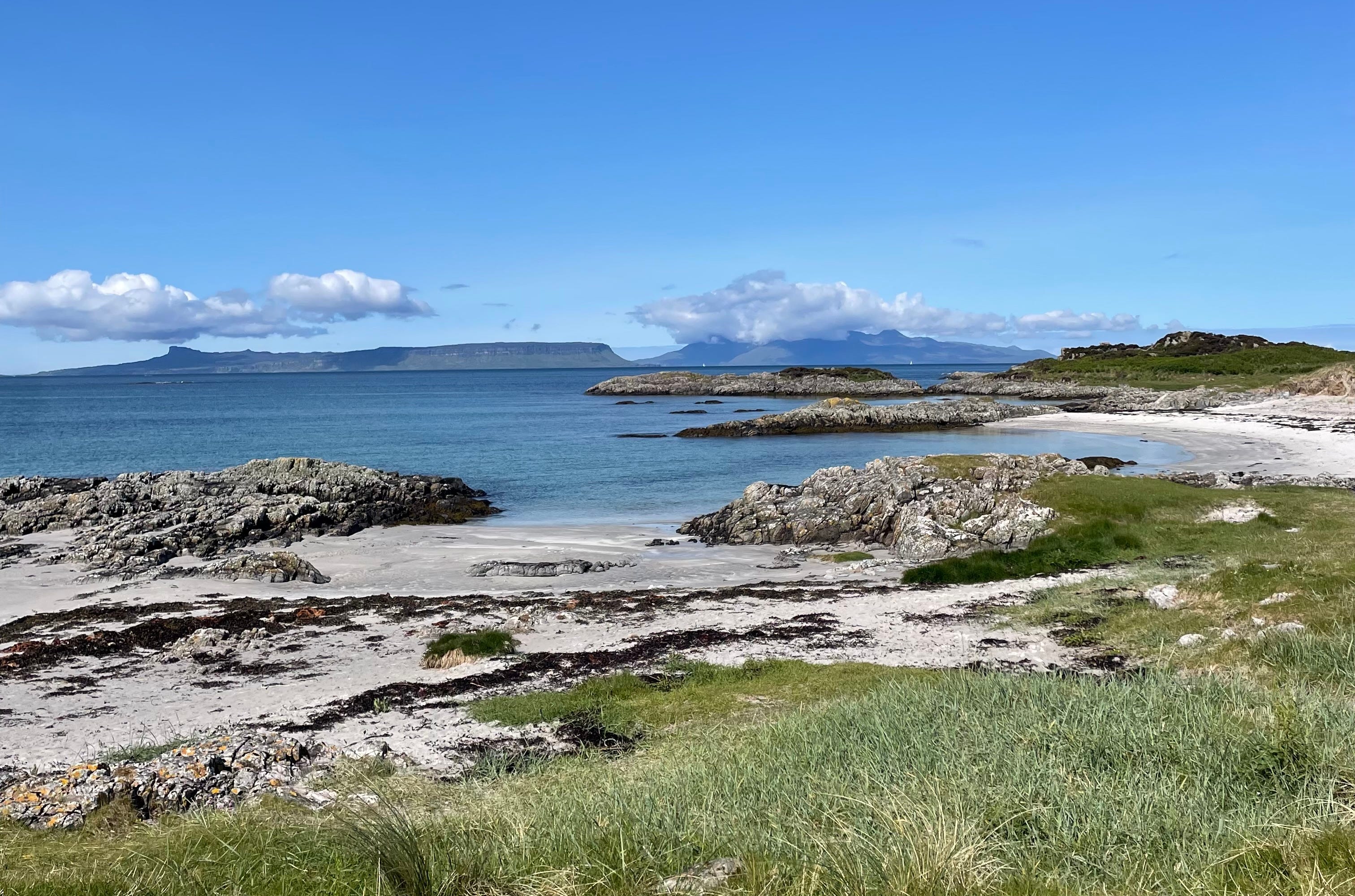
We were given the goodbye I’d envisaged when we took dad’s ashes to Arisaig beach, a collision of crystal water and white sand. Water had always been a bond; dad introduced me to surfing, dragged me out when I was scared, and watched me spend my childhood in the ocean as I grew up. Years before, he bobbed me in a sink in my nan’s kitchen, joy etched on his face, and took me to swimming lessons, encouraging me to feel my way in a new environment. Utterly empty, the beach’s beauty felt untouched as the Isles of Eigg, Rum and Skye enveloped us. I walked with the urn to the farthest rock, leant over and poured the ashes; they dissipated immediately this time, the sea welcoming each piece of dad for its own. I took off my shoes, then my socks, and stepped into the water, closing my eyes as my thoughts wrapped round the enormity of this moment. I felt more connected to dad than at any point since he’d died. My wife and sister joined me, and as we held each other and paddled in the ocean with dad, it struck me that there was no lesson that could have prepared us for this moment.
This is so well-written and beautiful, Cal. What a trip that was. Gorgeous photo too.
Very moving and beautiful Cal, thanks for sharing ❤️